
,,Whether you are managing a busy imaging core facility or pushing the boundaries of advanced cell biology in your own lab, you know the ultimate microscopy bottleneck: imaging thick, live 3D cultures always forces a frustrating compromise.
If you want high resolution, you risk photobleaching or killing your cells with intense lasers. If you want to image deep into a developing embryo, organoid, spheroid or thick tissue, it turns your Z-stacks into a blurry mess.
At INSCOPER, we believe that pushing scientific boundaries shouldn’t mean sacrificing your sample’s health. We are proud to introduce liveDRIM, our brand-new super-resolution solution designed to overcome the traditional trade-offs of live-cell and thick-tissue imaging.
The physics of robustness: Why random speckles outperform standard SIM
Conventional super-resolution methods (like standard SIM) rely on rigid, periodic light patterns. The moment that light hits a complex, scattering 3D environment, the pattern degrades, causing severe image artifacts.
liveDRIM changes the game by embracing randomness. Using advanced stochastic illumination, liveDRIM projects random speckle patterns that are inherently tolerant to optical aberrations and media scattering. Combined with our automated mathematical reconstruction, the system delivers high-fidelity images with super-resolution performance, capturing crisp subcellular detail deep within thick tissues without the phototoxic stress or speed limitations of conventional high-resolution setups.
Built for the diverse needs of advanced research labs
liveDRIM delivers the specific technical capabilities required to streamline multi-user facility workflows:
- True live super-resolution (~100 nm): Achieve a 2× lateral resolution improvement over standard widefield imaging. Capture high-fidelity biological dynamics, from actin networks and microtubules to mitochondrial remodeling and endocytosis.
- Deep tissue exploration (Up to 100 µm): Penetrate deep into samples with artifact-free clarity.
- Gentle, long-term kinetics: Rapid acquisition (2.5 to 12.5 fps) with a reduced photon dose means low phototoxicity. Keep your precious cells alive and healthy for multi-day, real-time dynamic studies.
- Instant on-the-fly previews: View an instant, super-resolved preview in real-time before you even launch your acquisition protocol.
- Camera full field of view: Zero cropping limitations. Maximize your data throughput by capturing the entire field of view your camera allows.
Zero sample prep overhead (keep your existing protocols)
One of the biggest complaints from core facility users is the tedious sample preparation required for high-end imaging. Using liveDRIM requires absolutely no specific preparation. Your lab members and facility users can continue using their standard fluorescent markers and everyday sample holders (slides, multi-well plates). It is fully compatible with standard multi-color, multidimensional (XYZT) imaging protocols.
Proven capabilities & peer-reviewed foundations
Powered by a core imaging technology validated in peer-reviewed literature, liveDRIM™ delivers the unique combination of speed, depth, and resolution required to excel across a diverse spectrum of complex biological models:
-
Neuroscience & synaptic mapping: Mapping dense, highly scattering neuronal networks and synaptic structures deep within brain slices and organoids.
-
Epithelial biology & organoid physiology: Resolving fine architectural features (such as dense microvilli borders, cell layers, and cellular junctions) deep within multi-layered epithelial tissues or organoids without losing structural definition.
-
Oncology screening & tumor spheroids: Tracking spheroid evolution across multi-well plates, such as real-time drug infiltration or live pathogen infection within a tumor mass without inducing phototoxic artifacts.
-
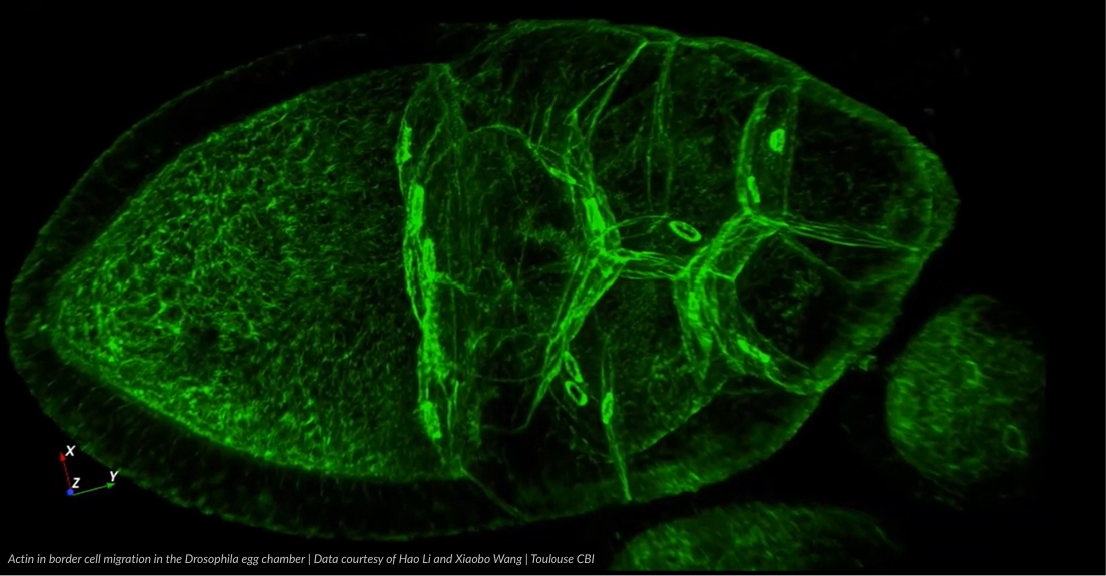
Developmental biology & morphogenesis: Visualizing deep embryonic structures and thick tissue layers with high-fidelity images without disrupting natural development (e.g., Drosophila embryos).
-
Intracellular dynamics & organelle trafficking: Tracking rapid, low-dose, long-term interactions of mitochondria, microtubules, and actin filaments in living mammalian cells without inducing phototoxic stress.
Visit our Publications page and filter on Super resolution (DRIM) to go through published papers and pre-prints.
Validated by science, engineered for the bench
liveDRIM™ is a collaborative deep-tech breakthrough combining the unique expertise of three industry players:
- Patented Technology by Rimeo: Based on the robust, peer-reviewed Random Illumination Microscopy (RIM) method (Mangeat et al., Cell Reports Methods, 2021).
- Manufactured by Gataca Systems: Precision-engineered optical modules built for flawless, long-term hardware integration.
- Powered by Inscoper: Driven by our signature real-time control engine, orchestrating high-speed acquisition and microsecond synchronization across your entire microscope setup.